Scratching The Surface

1628 Dundas St. W

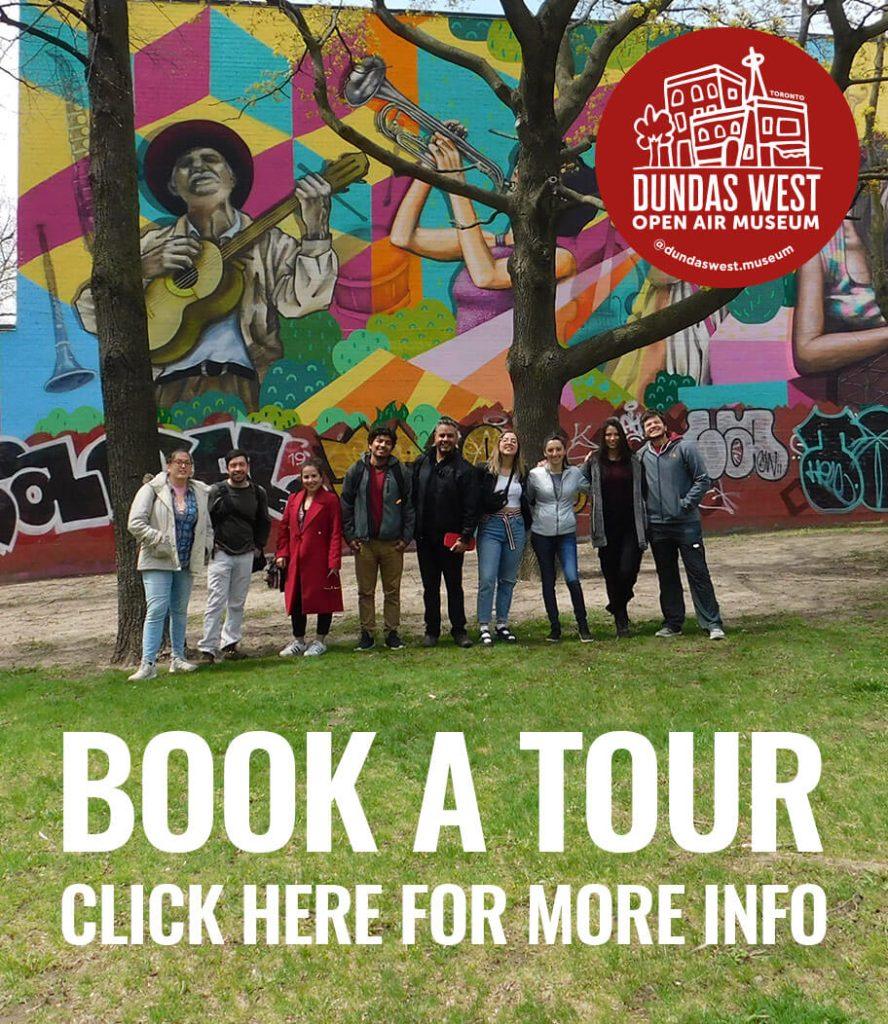
We offer personal tours of the Museum as a way to explore these spaces and learn more about the neighbourhood’s past and present. Tours are available in English, French, Spanish, and Portuguese. 

To request a tour please email: tours@dundaswest.museum  Tours must be booked in advance.

The Dundas West Museum acknowledges its location on “Dish With One Spoon” Haudenosaunee Confederacy territory, which today encompasses the city of Toronto. The city has witnessed the arrival of many cultures, several of which have made the Dundas West neighbourhood their home.

The Museum is situated in the ethnic enclave of Little Portugal (Pequeno Portugal / Aldeia Portugal in Portuguese).

 Located in Toronto’s West End, Little Portugal is bound by Lansdowne Ave to the west, College Street to the north, Ossington Ave to the east, and by the Go Transit and Union Pearson Express railway tracks to the south. The area is mainly residential, with Portuguese businesses along Dundas Street West and College Street.

The Dundas West neighbourhood has been shaped by the culture and creativity of the immigrants and artists who have resided there over the years. Their presence is felt in its local businesses and art studios. Being part of Little Portugal, Portuguese heritage is particularly apparent in these spaces, and is celebrated in outdoor public areas as well, such as in some of the murals on display in the Museum.
ABOUT THE ARTIST

VHILS
The acclaimed artist Vhils has created his first mural in Toronto, telling the story of a former Portuguese cleaning lady involved in the Cleaners’ Action movement that took place in the 1970’s. Cities have the raw materials and inspiration for Alexandre Farto (b. 1987), the acclaimed Portuguese artist known as Vhils, who made giant faces appear on urban facades, during the last decade all over the world. They are dug out in a dissection process meant to “reveal the insides” of these great cities. He has been interacting visually with the urban environment since his days as a prolific graffiti writer in the early-to-mid 2000s, until he realized that he was just “adding one layer over many others that have covered the walls over the years.” His work developed an ongoing reflection on contemporary urban societies and the complexity of the modern city. The artist uses subtractive methods of carving, cutting, drilling, and even blasting through with explosives, in a “creative destruction” process. This groundbreaking bas-relief carving technique – which forms the basis of the Scratching the Surface project. It was first presented to the public at the VSP group exhibition in Lisbon in 2007 and at the Cans Festival in London the following year. It has been hailed as one of the most compelling approaches to art created in the streets in the last decade. Vhils’ work, showcased around the world in both indoor and outdoor settings, has been described as brutal and complex, yet imbued with a simplicity that speaks to the core of human emotions. His work is an ongoing reflection on identity, on life in contemporary urban societies and their saturated environments. It speaks of effacement but also of resistance, of destruction yet also of beauty in this overwhelming setting, exploring the connections and contrasts, similarities and differences, between global and local realities. His first project in Toronto, ‘Cleaners’ Action’ movement reflects another case of human resistance, and a tribute to the Portuguese immigrant women who worked as janitorial workers in the high-rise office towers downtown and at the Queen’s Park Legislative Buildings in the 1970’s. Portuguese “cleaning ladies” have been a constant presence in the lives of countless Portuguese-Canadians as mothers, wives, breadwinners, community members, and activists. Torontonians, in general, are familiar with them, though mostly as archetypes of Portuguese immigrant women, without knowing much about their lives. Still, these working women, who have played a major role in up-keeping their families, communities as well as the city, remain largely invisible in the story of Toronto.